Ranger arrowhead badge

Nature Tracker

📒 Log Book

Lists sync across the family's phones (and still work offline). Passwords only prevent accidental taps; they are not real security.

🏆 Family leaderboard Connecting…

    Birds to find

    Tap ▶ to hear each bird. Filter by habitat:

    Sandhill Crane

    Sandhill Crane

    📅 Late Sep–mid Mar (peak mid-Dec)

    How to ID: Tall silver-gray bird, red cap on forehead, flies with neck straight out and legs trailing

    ⭐ Listen for a rolling, bugle-like call you can hear for miles

    🍽️ What it eats · 🧭 Where it comes from

    Eats: Omnivorous. Diet varies widely with location and season.

    Migration: The Sandhill Crane nesting in the north migrate long distances (some cross the Bering Straits every spring and fall, en route to and from nesting grounds in Siberia). Summer/nesting: Habitat varies with region, but usually nests around marshes or bogs, either in open grassland or surrounded by forest.

    Source: Audubon Guide to North American Birds

    Greater White-fronted Goose

    Greater White-fronted Goose

    📅 Fall–early spring

    How to ID: Brown goose, white band at base of pink-orange bill, dark bars on belly

    ⭐ Nicknamed 'specklebelly' for its spotty tummy

    🍽️ What it eats · 🧭 Where it comes from

    Eats: In winter, the Greater White-fronted Goose mostly eats seeds and waste grain in fields, also grazes on new growth.

    Migration: A long-distance migrant. Summer/nesting: Marshes, prairies, fields, lakes, bays; tundra in summer.

    Source: Audubon Guide to North American Birds

    Snow Goose

    Snow Goose

    📅 Fall–early spring

    How to ID: All white with black wingtips, pink bill

    ⭐ Big flocks look like snow swirling in the sky

    🔊 Hear it on xeno-canto
    🍽️ What it eats · 🧭 Where it comes from

    Eats: The diet of a Snow Goose is almost entirely plant material.

    Migration: Migrates long distances, in flocks, often flying very high. Summer/nesting: Tundra (summer), marshes, grain fields, ponds, bays.

    Source: Audubon Guide to North American Birds

    Northern Shoveler

    Northern Shoveler

    📅 Fall–spring

    How to ID: Huge spoon-shaped bill; male has green head, white chest, rusty sides

    ⭐ Spins in circles to stir up food

    🍽️ What it eats · 🧭 Where it comes from

    Eats: Variable depending on season and habitat.

    Migration: Migrates in flocks. Summer/nesting: In summer in open country such as prairie, marsh, or tundra, in vicinity of shallow water.

    Source: Audubon Guide to North American Birds

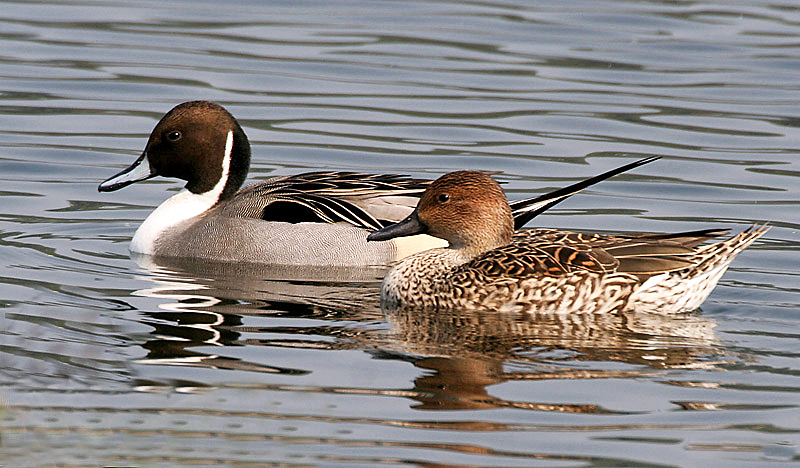
    Northern Pintail

    Northern Pintail

    📅 Fall–spring

    How to ID: Slim duck; male has chocolate head, white neck stripe, long pointed tail

    ⭐ Look for the 'pin' tail sticking up

    🍽️ What it eats · 🧭 Where it comes from

    Eats: The diet of a Northern Pintail is made up mostly of plant material in fall and winter, especially seeds of grasses, sedges, pondweeds, and others, and waste grain in fields.

    Migration: Migrates in flocks. Summer/nesting: Summers in wide variety of open habitats, including prairies, farmland, northern tundra, near bodies of water.

    Source: Audubon Guide to North American Birds

    Green-winged Teal

    Green-winged Teal

    📅 Fall–spring

    How to ID: Tiny duck; male has chestnut head with green eye-patch

    ⭐ One of the smallest ducks — count how many you see

    🔊 Hear it on xeno-canto
    🍽️ What it eats · 🧭 Where it comes from

    Eats: The diet of the Green-winged Teal is quite variable with season and location. Feeds especially on seeds of grasses, sedges, pondweeds, many others.

    Migration: After breeding, adults may go through annual molt near nesting area or may move hundreds of miles in late summer before going through flightless stage of molt. Summer/nesting: In summer, open country near shallow freshwater lakes and marshes.

    Source: Audubon Guide to North American Birds

    American Coot

    American Coot

    📅 Year-round, most in winter

    How to ID: Black, chicken-like, white bill; lobed (not webbed) toes

    ⭐ Runs across the water to take off

    🍽️ What it eats · 🧭 Where it comes from

    Eats: Omnivorous. Eats mostly plant material, including stems, leaves, and seeds of pondweeds, sedges, grasses, and many others, also much algae.

    Migration: Some populations probably permanent resident, others migratory. Summer/nesting: For breeding season requires fairly shallow fresh water with much marsh vegetation.

    Source: Audubon Guide to North American Birds

    Black-necked Stilt

    Black-necked Stilt

    📅 Most of year

    How to ID: Black-and-white with very long bright pink legs

    ⭐ Looks like it's walking on stilts

    🍽️ What it eats · 🧭 Where it comes from

    Eats: The Black-necked Stilt feeds on very small creatures that live on or near surface of water, including many flies, beetles, and other insects, shrimp, crayfish, snails; sometimes eats tadpoles or tiny fish.

    Migration: Vacates most inland areas in winter, moving to coasts, and some may migrate well to the south. Summer/nesting: For nesting, requires bare open ground near water, with little vegetation.

    Source: Audubon Guide to North American Birds

    Long-billed Dowitcher

    Long-billed Dowitcher

    📅 Fall–spring

    How to ID: Chunky gray shorebird with a very long straight bill

    ⭐ Feeds like a sewing machine, poking its bill up and down

    🔊 Hear it on xeno-canto
    🍽️ What it eats · 🧭 Where it comes from

    Eats: The diet of a Long-billed Dowitcher probably varies with season.

    Migration: From breeding range in far northwest, many migrate southeast to reach Atlantic seaboard. Summer/nesting: The Long-billed Dowitcher breeds in far north on wet, hummocky tundra.

    Source: Audubon Guide to North American Birds

    Killdeer

    Killdeer

    📅 Year-round

    How to ID: Brown plover with two black neck bands

    ⭐ Yells its name: 'kill-deer!' and may fake a broken wing near its nest

    🍽️ What it eats · 🧭 Where it comes from

    Eats: Mostly insects.

    Migration: Migratory in north, may be permanent resident in south. Summer/nesting: Most successful nesting areas, however, have some shallow water or other good feeding area for the chicks.

    Source: Audubon Guide to North American Birds

    Greater Yellowlegs

    Greater Yellowlegs

    📅 Fall–spring

    How to ID: Tall gray shorebird with bright yellow legs; loud 3-note call

    ⭐ Check the legs — they really are yellow

    🍽️ What it eats · 🧭 Where it comes from

    Eats: In the breeding season, a Greater Yellowlegs probably feeds mostly on insects and their larvae.

    Migration: Usually migrates in small flocks. Summer/nesting: Open marshes, mudflats, streams, ponds; in summer, wooded muskeg, spruce bogs.

    Source: Audubon Guide to North American Birds

    Great Egret

    Great Egret

    📅 Year-round

    How to ID: Tall all-white heron, yellow bill, black legs

    ⭐ Stands perfectly still, then stabs fish fast

    🍽️ What it eats · 🧭 Where it comes from

    Eats: Mostly fish. Aside from fish, also eats crustaceans, frogs, salamanders, snakes, aquatic insects. In open fields may catch grasshoppers, rodents.

    Migration: Withdraws in winter from northern breeding areas, wintering only where waters remain open. Summer/nesting: Usually nests in trees or shrubs near water, sometimes in thickets some distance from water, sometimes low in marsh.

    Source: Audubon Guide to North American Birds

    Great Blue Heron

    Great Blue Heron

    📅 Year-round

    How to ID: Very tall blue-gray heron, flies with neck folded in an S

    ⭐ Taller than many kids — about 4 ft

    🍽️ What it eats · 🧭 Where it comes from

    Eats: Highly variable and adaptable. The Great Blue Heron eats mainly fish, but also frogs, salamanders, turtles, snakes, insects, rodents, and birds.

    Migration: Northern populations east of the Rockies are migratory, some going to the Caribbean, Central America, or northern South America. Summer/nesting: Nests in trees or shrubs near water, sometimes on the ground in areas free of predators.

    Source: Audubon Guide to North American Birds

    White-faced Ibis

    White-faced Ibis

    📅 Most of year

    How to ID: Dark bird with long down-curved bill; glossy green-purple in sun

    ⭐ Bill curves like a banana

    🔊 Hear it on xeno-canto
    🍽️ What it eats · 🧭 Where it comes from

    Eats: The White-faced Ibis feeds on aquatic insects and their larvae, as well as those living in damp soil. Eats many crayfish and earthworms.

    Migration: Present all year in southern California and coastal Texas and Louisiana; migratory elsewhere.

    Source: Audubon Guide to North American Birds

    Northern Harrier

    Northern Harrier

    📅 Year-round, more in winter

    How to ID: Flies low over fields with wings in a V; white patch at base of tail

    ⭐ Has an owl-like face to hear mice in the grass

    🔊 Hear it on xeno-canto
    🍽️ What it eats · 🧭 Where it comes from

    Eats: Mostly small mammals and birds. Diet varies with location and season.

    Migration: Some southern birds may be permanent residents, but northern ones migrate. Summer/nesting: Often found in marshes, especially in nesting season, but sometimes will nest in dry open fields.

    Source: Audubon Guide to North American Birds

    Red-tailed Hawk

    Red-tailed Hawk

    📅 Year-round

    How to ID: Big hawk, pale chest with dark belly band, rusty tail on adults

    ⭐ Often perched on poles along the roads

    🍽️ What it eats · 🧭 Where it comes from

    Eats: Varied, includes small mammals, birds, and reptiles. The Red-tailed Hawk diet varies with location and season.

    Migration: Northern Red-tailed Hawks may migrate far to the south, while many at central or southern latitudes (especially adults) are permanent residents.

    Source: Audubon Guide to North American Birds

    Bald Eagle

    Bald Eagle

    📅 Fall–winter visitor; preserve surveys logged one in Oct 2025 and Feb 2026

    How to ID: Huge dark-brown eagle; adults have a bright white head and tail and a big yellow bill (young birds are mottled brown for about 5 years)

    ⭐ It's the USA's national bird — and its call is a surprisingly squeaky, giggly chatter

    🍽️ What it eats · 🧭 Where it comes from

    Eats: Mostly fish when available, including salmon, herring, catfish, carp, and many others.

    Migration: Migratory behavior in Bald Eagle varies across North America populations, varying with age, breeding location and climate, and winter prey availability; many migratory movements align with salmon migrations in Pacific Northwest and Alaksa.

    Source: Audubon Guide to North American Birds

    White-tailed Kite

    White-tailed Kite

    📅 Year-round

    How to ID: White and pale gray with black shoulders; hovers in place

    ⭐ Hovers like a helicopter before diving

    🔊 Hear it on xeno-canto
    🍽️ What it eats · 🧭 Where it comes from

    Eats: The White-tailed Hawk eats mostly small rodents. Specializes on small rodents that are active by day in open country, particularly voles and house mice.

    Migration: The White-tailed Kite has no regular migration, but wanders widely. Summer/nesting: Main requirements seem to be trees for perching and nesting, and open ground with high populations of rodents.

    Source: Audubon Guide to North American Birds

    Great Horned Owl

    Great Horned Owl

    📅 Year-round

    How to ID: Large owl with ear tufts and yellow eyes

    ⭐ Listen at dusk for deep 'hoo-h'HOO-hoo-hoo'

    🍽️ What it eats · 🧭 Where it comes from

    Eats: Varied, mostly mammals and birds. Mammals make up the majority of the Great Horned Owl diet in most regions.

    Migration: No regular migration, but individuals may wander long distances in fall and winter, some of them moving southward. Summer/nesting: In breeding season, the Great Horned Owl avoids tundra and unbroken grassland, since it requires some trees or heavy brush for cover.

    Source: Audubon Guide to North American Birds

    Red-winged Blackbird

    Red-winged Blackbird

    📅 Year-round

    How to ID: Male black with red-and-yellow shoulder patches

    ⭐ Sings 'conk-la-ree!' from cattails

    🍽️ What it eats · 🧭 Where it comes from

    Eats: Mostly insects and seeds.

    Migration: Present throughout the year in many areas. Summer/nesting: The Red-winged Blackbird breeds in marshes, brushy swamps, and hayfields; it also forages in cultivated land and along edges of water.

    Source: Audubon Guide to North American Birds

    Marsh Wren

    Marsh Wren

    📅 Year-round

    How to ID: Small brown wren with white eyebrow, tail cocked up; hides in tules

    ⭐ Easy to hear, hard to see — a fun hide-and-seek bird

    🍽️ What it eats · 🧭 Where it comes from

    Eats: The Marsh Wren feeds on a wide variety of insects, including beetles, flies, moths, caterpillars, ants, grasshoppers, and many others.

    Migration: Probably migrates at night. Summer/nesting: Breeds in many fresh and brackish marsh situations, usually with a large area of cattails, bulrushes, or cordgrass; also in other kinds of low rank growth along shallow water.

    Source: Audubon Guide to North American Birds

    Black Phoebe

    Black Phoebe

    📅 Year-round

    How to ID: Small black flycatcher with white belly; pumps its tail

    ⭐ Says its name: 'fee-bee'

    🍽️ What it eats · 🧭 Where it comes from

    Eats: The diet of a Black Phoebe consists almost entirely of insects.

    Migration: Mostly a permanent resident, but departs in fall from highest elevations and from northern edge of its range in southwestern United States. Summer/nesting: Rarely found away from vicinity of water, which may be natural streams or ponds, or irrigation ditches or even water troughs; water ensures the availability of mud for nests.

    Source: Audubon Guide to North American Birds

    Tree Swallow

    Tree Swallow

    📅 Most of year

    How to ID: Shiny blue-green back, snowy white front; swoops over water

    ⭐ Catches bugs in mid-air

    🍽️ What it eats · 🧭 Where it comes from

    Eats: Mostly insects, some berries. Diet is mostly insects, especially in summer. Feeds on many flies, beetles, winged ants, and others.

    Migration: Migrates north relatively early in spring. Summer/nesting: May breed in any kind of open or semi-open area that provides both nesting sites and a good supply of flying insects.

    Source: Audubon Guide to North American Birds

    White-crowned Sparrow

    White-crowned Sparrow

    📅 Fall–spring

    How to ID: Gray sparrow with bold black-and-white striped head

    ⭐ Head looks like it's wearing a striped helmet

    🍽️ What it eats · 🧭 Where it comes from

    Eats: The diet of the White-crowned Sparrow consists mostly of seeds, other vegetable matter, and insects.

    Migration: Some populations of the White-crowned Sparrow on the Pacific Coast are permanent residents; those from northern and mountain regions are strongly migratory. Summer/nesting: The White-crowned Sparrow thrives in varied breeding habitats, but always in brushy places, such as dwarf willow thickets at the edge of tundra, bushy clearings in northern forests, scrub just below the timberline in mountains, chaparral, and well-wooded suburbs along the Pacific Coast.

    Source: Audubon Guide to North American Birds

    🎤 Listen & Identify (live)

    Tap Start listening, allow the microphone, and hold your phone toward the birds. The BirdNET model runs right on your device (no audio is uploaded) and shows what it hears every 1.5 seconds. Birds from this guide light up below. Results are tuned to Cosumnes and this week of the year.

    Preparing…

      Powered by BirdNET (Cornell Lab of Ornithology & Chemnitz University of Technology) via the open-source BirdNET Live app (MIT). Models CC BY-SA 4.0. Prefer an app? BirdNET Live · Merlin Sound ID.

      Right now: late October

      Crane season has started. Sandhill Cranes usually arrive in late September, peak in mid-December, start leaving in early February, and are mostly gone by mid-March. Geese and ducks are arriving for winter too.

      The cranes sleep in ponds at night and feed in fields and ponds by day. Come at sunrise or sunset to see them fly in or out; come midday to see them standing in the ponds. More than 250 bird species have been seen on or near the Preserve (BLM); the eBird hotspot lists 260.

      Where to look

      Lost Slough Wetlands Boardwalk

      Wheelchair-accessible boardwalk over wetlands, linked to the Visitor Center by a 1-mile trail. Great for ducks, geese, and cranes. Open daily 9 AM–4 PM per BLM.

      Visitor Center & Wetlands Walk

      Exhibits include a sandhill crane specimen and a touch table. The deck is open even when inside is closed. Wetlands Walk is good crane and waterfowl habitat.

      Desmond Road (by car)

      Recommended by the Preserve for crane viewing at dawn and dusk. Pull fully onto the shoulder to stop.

      Woodbridge Ecological Reserve

      Isenberg Crane Reserve, ~20 min drive. South Site open any time; needs a CDFW Lands Pass or hunting/fishing license. Sunset fly-in is the highlight. Stay in your car on the road — grain trucks move fast.

      Staten Island Road

      Flooded fields draw thousands of birds in fall and winter. Stay on the public road; levees and fields are private.

      Plan your visit

      Address13501 Franklin Blvd, Galt, CA 95632
      CostFree
      TrailsSunrise to sunset
      Parking gatesBoardwalk & lower lot 9 AM–5 PM; upper lot 9 AM–6:30 PM
      Visitor CenterClosed Mon & Tue; weekends usually 9 AM–5 PM
      DogsNot allowed (service animals only)
      AccessibilityBoardwalk and Visitor Center restrooms are ADA accessible
      Crane toursCDFW docent tours at Woodbridge, usually first three weekends of each month Oct–Feb; pre-registration required

      ℹ️ Gates close before sunset this time of year, so for a sunset crane fly-in, park at the upper lot or watch from Woodbridge Road.

      Kid-friendly tips

      1. Listen first — cranes' bugling and geese honking are easy to hear before you see them.
      2. Play bird bingo — spot a crane, an egret, a duck with a green head, and a hawk on a pole.
      3. Bring binoculars and layers — birds keep their distance, and mornings and evenings get chilly.
      4. Quiet voices, stay on trails — birds spook easily, and paths protect their homes.
      5. Visit the touch table at the Visitor Center.

      Sources

      Photo & audio credits

      All media from Wikimedia Commons (many recordings originally from xeno-canto), used under the licenses listed. Audio trimmed to 40 s; photos resized.